Darwin's Journey

Home Background Discovery→Theory Sitemap

Charles Darwin boarded the HMS Beagle on a crisp winter morn in December of 1831. On his voyage, he found evidence which supported his developing theory of evolution. This voyage is one of the most famous scientific expeditions because of its ties to one of the questions of existence.
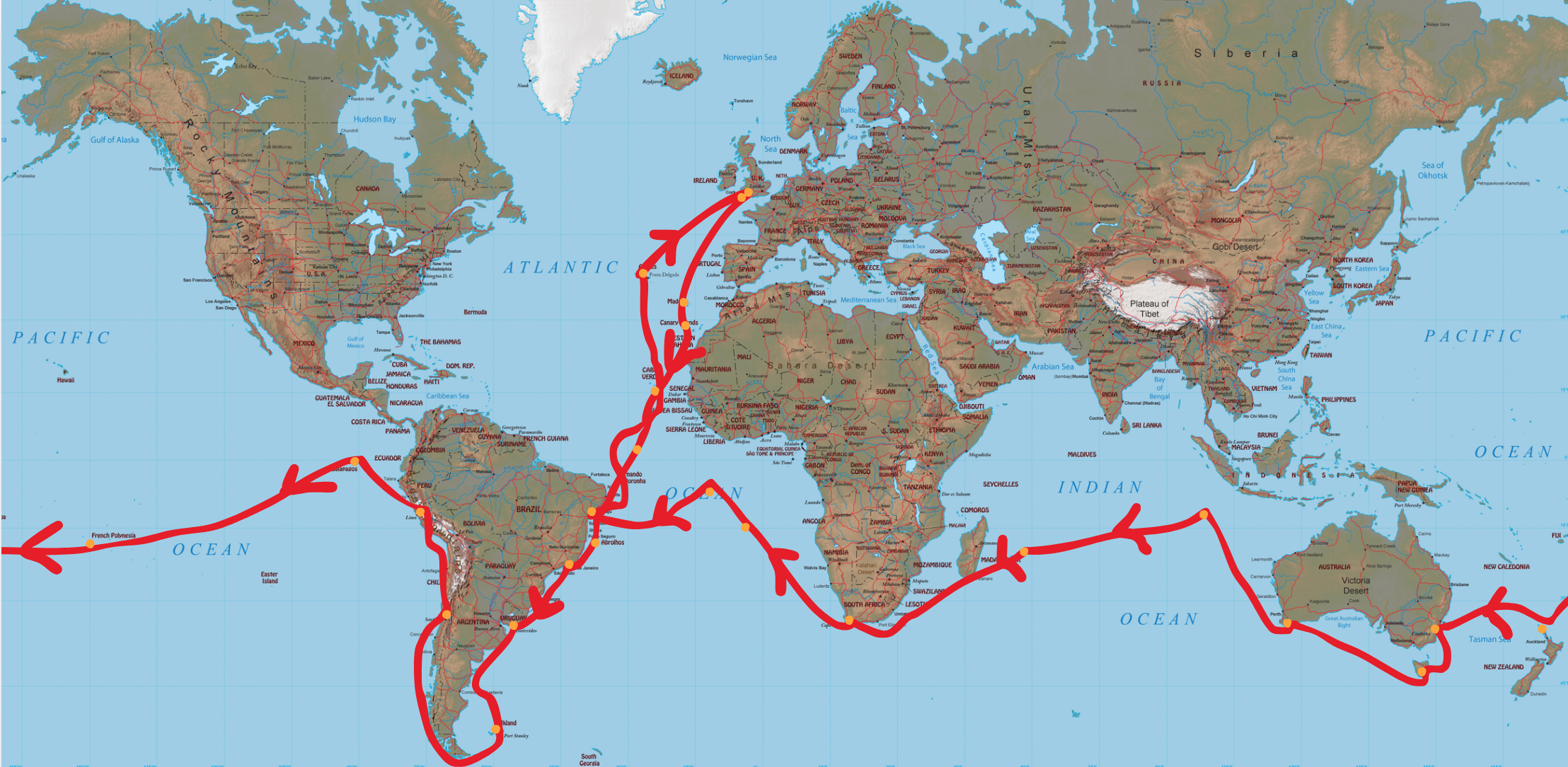
December 27, 1831: Plymouth, England
Charles Darwin sets sail aboard a ship as its naturalist, the HMS Beagle which was captained by Lieutenant Robert Fitzroy.

December, 1831: Madeira Islands
Passed through

December, 1831: Canary Islands
Passed through

January, 1832: Cape Verde Islands;
1836: Praia

1832: St. Peter and St. Paul rocks
Passed through

1832: Salvador de Bahia
Here, Darwin was dazzled by the rainforest, but noticed local slavery.
1836: Bahia Blanca
Darwin often visited this area, and discovered the fossils of large mammals.

1832: Abrolhos Archipelago
Passed Through

1832: Rio De Janeiro
The rainforests here housed many wonderful creatures, but also some that made Darwin later declare that nature did not have a beneficent design.

July, 1832: Montevideo
There was a rebellion taking place when Darwin landed, and so he helped the nearby sailors to take back the rebel-held fort.

March, 1833: Falkland Islands
Here, Lieutenant Fitzroy used the HMS Beagle and others to take the Falkland Islands from the Argentines for the British.

July, 1834;1835: Valparaíso, Chile
Darwin climbed the Andes Mountains in search of how the mountains got there in the first place

September, 1835: Callao
Passed through

1835:Galapagos Islands
Despite its legends, these prison islands did not make Darwin suddenly discover evolution; he only vaguely noted a few differences in mockingbirds and finches, and took pets of tortoises.

November, 1835: Tahiti, New Zealand
The HMS Beagle was heading home.

December, 1835: Bay of Islands
The HMS Beagle was heading home.

1835: Sydney
In its later third voyage, the ship named two areas in Australia, Port Darwin and Fitzroy River.

1835: Hobart
The HMS Beagle was heading home.

1835: King George Sound
The HMS Beagle was heading home.

April, 1836: Cocos (Keeling) Islands
Darwin hypothesized (correctly) how coral reefs formed based on his observations.

1836: Mauritius Island
The HMS Beagle was heading home.

May, 1836: Cape of Good Hope
Darwin talked to an astronomer, Sir John Herschel, most likely about Lyell’s theory of changing land.

July, 1836: St. Helena Island
On his way home, Darwin was cataloguing the thousands of specimens he collected.

1836: Ascension Island
He began to piece together his discoveries on the last leg of the trip.

September, 1836: Azores Archipelago
His ride home, though, only brought him more questions.

October 2, 1836: Falmouth, England
When he landed, Darwin had new courage to challenge conventional Victorian reasoning.

© Emiko 2026

Sources · Credits

In March of 1833 Darwin’s father wrote to him (one of only three letters sent during the voyage): “In consequence of the recommendation in your first letter I got a Banana tree. I sit under it and think of you in similar shade.”

On his voyage, Darwin was prone to seasickness.